
Buenos Aires
Inside a Porteño landmark: The Buenos Aires Obelisk

Share whith yours friends:


Tags:
obelisk buenos aires
The familiar sight of a tall, needle-like Obelisk can often be seen in the majority of large, famous cities around the world. The original monuments date back to Egyptian times and the landmarks paid respect to the god of the Sun, but what is the history behind the Buenos Aires Obelisk, probably the most photographed landmark in Buenos Aires [caption id="attachment_6426" align="alignnone" width="640"] The Buenos Aires Obelisk at Night / source[/caption]
  Corrientes Avenue at night / source[/caption]If you are looking for tours and activities in Buenos Aires during the Autumn, visit our official website
 The Buenos Aires Obelisk at Night / source[/caption]
 About the Buenos Aires Obelisk:
The Buenos Aires Obelisk is the most celebrated monument in Buenos Aires to the point that it has gained the reputation of being a national icon and the heart of the nation of Argentina putting it on a par with other national icons such as the Plaza de Mayo, the Casa Rosada or even the popular Maradona. This notable and recognized landmark in Buenos Aires was built in 1936 and constructed by 157 workers in just 31 days to commemorate the fourth centenary of the foundation of the city. The National Historical Monument is located in Plaza de la Republica at the intersection of the busy and vibrant Microcentro avenues of Corrientes and 9 de Julio. The Obelisco was constructed as much more than just a landmark, as it stands as a political icon with the National Flag being raised there for the first time when Argentina was declared an Independent State. Although the Obelisco has an entrance on its west side, as a result of a number of protests and graffiti, the monument has been surrounded by a fence to protect it since 1987. If you were to walk up the 206 steps on the inside of the Buenos Aires Obelisk to the summit, you would be able to look out of the 4 windows providing, what we can only imagine as an uninterrupted, incredible and stunning view of the entire city of Buenos Aires. Hopefully, one day, the Buenos Aires Obelisk will again be opened for all to enjoy the probable breath-taking view. The four faces of the Buenos Aires Obelisk have inscriptions describing or remembering a historical event that took place in the city of Buenos Aires. However, if your Spanish is not up to scratch, do not worry as here are the translations of the four faces of the Buenos Aires Obelisk: - North: “On this site in the St. Nicholas tower the Flag was raised for the first time in the city on the 23rd August 1812”. - South: “Second Foundation of the city of Buenos Aires by Juan de Garay on the 11th July 1580”. - East: “To the Republic of Buenos Aires on the 4th centenary of the foundation of the city by Don Pedro de Mendoza on the 2nd February of 1536”. - West: “Capital Federal Law enacted by the Congress on the 20th September 1880 with the initiative of the President Nicolás Avellaneda and Decree of the President Julio A. Roca on the 6th December 1880. On the side facing south, at its base in a very small rectangle is a poem by Baldomero Fernández Moreno.More than just an Obelisk:
Celebrations, political demonstrations, sports achievements and groups wishing to publicize their beliefs, use the Obelisk to stage these events and usually go on to march to the Casa Rosada. The Buenos Aires Obelisk was most notably used on the 1st December 2005 to commemorate World AIDS Day and was covered by a giant pink condom and on the 30th Anniversary of the “Night of the Pencils” (La Noche de los Lápices) in 2006, when it was transformed into a pencil to pay tribute to those students who were kidnapped and murdered. At the end of the 2011 Apertura tournament, Boca Juniors fans used the Obelisk as the centre of their celebrations for winning the cup. The Buenos Aires Obelisk can be fully enjoyed at any time of the day and night, and the constant excitement of the many theatres and restaurants along, Avenida Corrientes, will offer you the best view of the Obelisk in Buenos Aires whilst giving you a perfect sense of the typical Porteño lifestyle. If you want to peacefully enjoy Downtown Buenos Aires during the day whilst sightseeing, you can take the small pedestrianized Diagonal Norte between Cerrito and Libertad, stop for a coffee in one of its classic cafés and enjoy watching the hustle and bustle of the big avenues surrounding it. Whilst passing by the Plaza de la Republica, be careful of your personal belongings as people can take advantage of distracted tourists. [caption id="attachment_6427" align="alignnone" width="640"]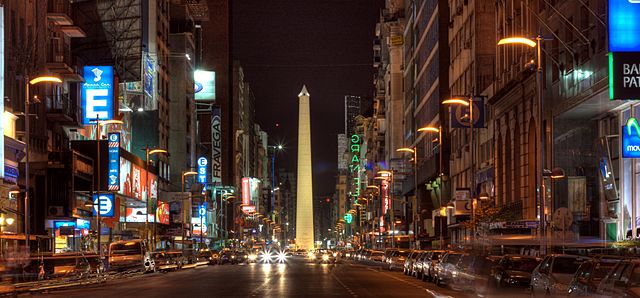 Corrientes Avenue at night / source[/caption]If you are looking for tours and activities in Buenos Aires during the Autumn, visit our official website
Share whith yours friends:
Tags:
obelisk buenos aires
Search


Popular Tags
-
Iguazu Falls Brazilian Side TourfromUS$46
-
Exciting 4x4 route: São Luís and FortalezafromUS$2,250
-
-
Full Day Cafayate Tour from SaltafromUS$39
-
-
Transfer Ezeiza - AeroparquefromUS$107
-
-
-
-
-
-
-
-
Tierra del Fuego National Park Tour with Optional End of the World Train in UshuaiaRating:100% of 100fromUS$69
-
-
-
-
-
-
-
-
Daytours4u © 2012-2019. Use of this website constitutes acceptance of the Terms & Conditions.
Open Chat
Hello, How May I Help You?